Showing posts with label Biodiversity. Show all posts

7 Sept 2022

Coa Valley Ecological Art part2

Greater Côa Valley residency - Wild Côa Symphony

Creative Team: ecological artist Antony Lyons, archaeologist Bárbara Carvalho and musician Jesse D. Vernon.

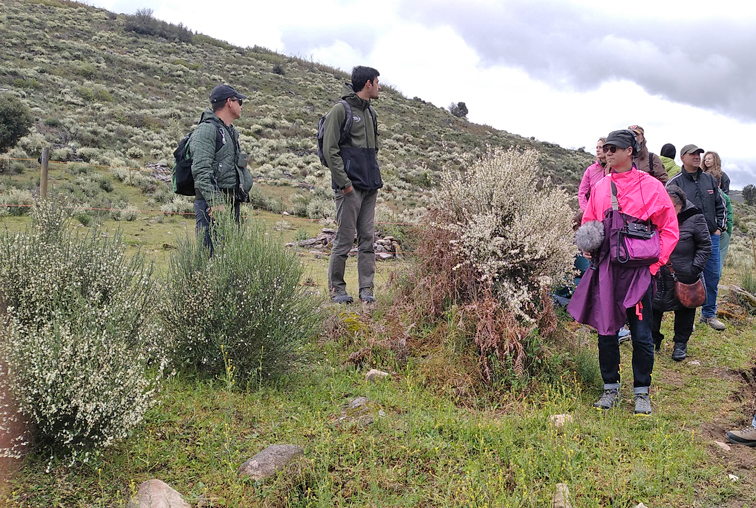
Music and sonic walk in Vale Carapito
 

Situated in an an ecological regeneration area, the aim of our collaborative working is to establish a space – real and metaphorical – for the co-creation of a video-sonic ‘portrait’ with which people can genuinely feel an emotional relationship, and which can continue to evolve over time.

22 Jun 2022

Coa Valley Ecological Art

Wild Côa Symphony. A 1-year artist residency project with the Endangered Landscapes Programme & Rewilding Portugal. Summer 2022 update. 

[Extracted from a news article on the ELP website, and including personal reflections from primary creative collaborator on Wild Côa Symphony, Bárbara Carvalho, creative ethnographer, Portugal]

Imaginative weavings of landscape, ecologies and communities:
Working closely with local communities in the Côa Valley, the ecological artist, Antony Lyons, and public archaeologist, Bárbara Carvalho, have been exploring this impressive riverine landscape

16 Dec 2021

How Wild Is My Valley

wanderings, wonderings and ponderings in two valleys

“All that is gold does not glitter
Not all those who wander are lost”

Bilbo Baggins, describing Strider, in Lord Of The Rings, JRR Tolkein

Last summer, I was back in the sanctuary - or retreat - of the ‘artist cottage’

26 Oct 2021

The Hills Are Alive

The Hills Are Alive...


[Adapted from published catalogue text] In Autumn 2020, invited by Artefact Projects in Stirchley, Birmingham, I set out to weave together field recordings (video and sonic) from two places - the Elan Valley in Wales and River Rea trail that passes through Stirchley.

7 Mar 2021

Lovely Weather

The Lovely Weather Donegal Residencies was a Leonardo/Olats art-and-climate project that took place in Donegal, Ireland, in 2009-10. As one of 5 commissioned artists, my artist-residency project - titled WeatherProof - was undertaken in the River Finn Valley. Recently I have written responses to researcher questions about the residencies. They are presented below.


Q: The level of community engagement and how this was organised

My understanding is that there was a high degree of community engagement extending through all stages of the project. I wasn’t involved with the inception, but I know that elected representatives were involved with the initial stages and selection of artists...

17 Jul 2017

Landscapes In Limbo - part1

Section of Google-Earth track of first joint field trip by Antony Lyons and Caitlin DeSilvey in Cornwall in 2014
Landscapes in Limbo

JULY 2017
part 1 - juxtapositions and speculations


Two years into a four-year creative research involvement with the boundary-pushing academic project, Heritage Futures, I’m taking stock of what’s slowly emerging within my field of view; attending to the germinating seeds of some site-inspired video-sonic creative responses - or activations - in three 'landscapes in limbo'.

23 Aug 2014

Return of The Aliveness Machines

Posters produced for exhibition at RGS conference in London next week. A platform for a new development phase of The Aliveness Machines - first seen in Devon in 2012. A NOVA research project.


7 Jul 2014

Evidence plus Inspiration (in the field)

Professor Poole - wild man of the marshes
"Concern over climate change and rising sea level, coupled with recent extensive flooding across Europe, reminds us that wetlands, ranging from extensive coastal marshes to inland river floodplains, still dominate the landscape of many regions. In an era of intensive settlement and agriculture we often see water in such landscapes as a problem and complex drainage and flood defence systems have been constructed to control their watertables. In the past, however, water was perceived more as a resource..." 

10 May 2014

Eco-Art Dialogues

 Revegetated clay waste-lands, Cornwall, 2013
Some preparatory musings, questions and themes - prepared in advance of my a-n Re:View conversations with Glasgow-based environmental artists, Tim Collins and Reiko Goto. Our time together will include a visit to their current main field-based project at the Black Wood of Rannoch. Our continuing dialogues will be documented via an a-n Artists Talking blog.

9 May 2014

A Myriorama of Oblique Strategies

View from the freshly shored up rail-line at Dawlish, en-route to Falmouth
The photo here was taken on a trip to a seminar/ 'melting pot' at the Environment and Sustainability Institute in Cornwall, where I recently presented some glimpses (or a myriorama) of a drifting creative journey through the realms of science and eco-art, towards some substantial research-based collaborations.

3 Apr 2013

Submerged (Drowned Lands)

Chew Valley Lake, July 2013
Submerged (Drowned and Dammed Lands)

[aka The Almanac of the Submerged]

Environmental artist Antony Lyons is working with others, including Professor Steve Poole (UWE-Bristol/Regional History Centre, Bristol) on an Arts Council England funded initiative, involving creative fieldwork, community conversations/voices and research at a number of locations. The first phase of the project runs from Spring 2013 to late 2014.

The approach involves a creative and poetic response to a variety of landscape and cultural settings that are affected by changing water-levels. The unifying theme is that the waters come, the waters inexorably rise. Then everything is changed (and the waters recede...)

14 Feb 2012

The Dark Side

Fields and the River Torridge, Torrington, November 1983: James Ravilious © Beaford Arts
On the subject of 'shadows', and delving into hidden landscape realms, there is - in an eco-symbolic sense - perhaps also a parallel in the human unconscious? Jung credited Gustav Carus (1789-1869) with pointing to the unconscious as the essential basis of the dark side of the psyche. A contemporary of Goethe, Carus was a physiologist, writer, geologist, naturalist…and a landscape painter. A true polymath, he urged artists to study the 'physiognomy' of landscape and 'learn to speak the language of nature.' There is a darkness (a crepuscularity?) to many of Carus' paintings...